
Every so often a report lands that the whole industry should read twice. Once for what it says. And once for what it proves without meaning to.
The Semrush AI Visibility Index 2026 — published with Adobe — is one of the largest studies of AI brand visibility ever run: 126 million real user prompts, four AI platforms, twenty-two verticals, measured from January through April 2026. It is careful, well-built work, and I want to say so plainly. When a dataset this size becomes public, everyone in this field gets smarter.
But here is what struck me most reading it. Page after page, finding after finding, the data keeps arriving at the same destination — the one I have been describing all along.
What the data actually shows
Start with the finding Semrush themselves place above all others: the brands winning AI visibility are not the ones publishing the most. They are the ones whose signals say the same thing everywhere — on their own site and across the third-party sources AI trusts.
Patagonia is their flagship example. An AI Visibility score of 79 out of 100, held at 79 or 80 in every single month of the measurement window, across four platforms that otherwise disagree with each other constantly. And the mechanism behind that stability was not paid media, not content volume, not classic SEO. It was six specialist outdoor-gear publications describing the brand consistently — generating over 65,000 brand mentions in AI answers, more than the entire Tier 1 traditional media combined.
- 79–80
- Patagonia's visibility score, every month, January–April 2026 — earned upstream, in the trust network.
- 65,000+
- Mentions from six specialist gear sites — more than all Tier 1 traditional media combined.
- 12 months
- Semrush's stated minimum for compounding — sustained presence, not a one-time campaign.
Shopify tells the same story from the software side. In April 2026, on Google AI Overviews alone, Shopify was mentioned 45,098 times and cited 46,342 times — near-perfect balance between being talked about and being quoted from, a balance Semrush notes most brands cannot achieve. Behind it: 42,100 unique cited pages and 222 individual topics scoring above 90 on their visibility measure. That is not a campaign. That is an ecosystem, compounded over years.
The report’s ceiling tells the same story. The “Universal 36” — the only brands appearing in every platform’s top 100, every month — are almost all decades old. LEGO, their example of category dominance at a score of 88, built its position across generations. Semrush’s own warning to marketers is that compounding requires a minimum of twelve months of sustained presence, and that a strategy aimed at displacing the universal brands will fail.
There is a word for what this data describes. Brands are not winning visibility. They are earning trust, and AI is converting that trust into visibility on their behalf.
Four platforms, four different answers
Now look at what happens when you measure only the end of the chain.
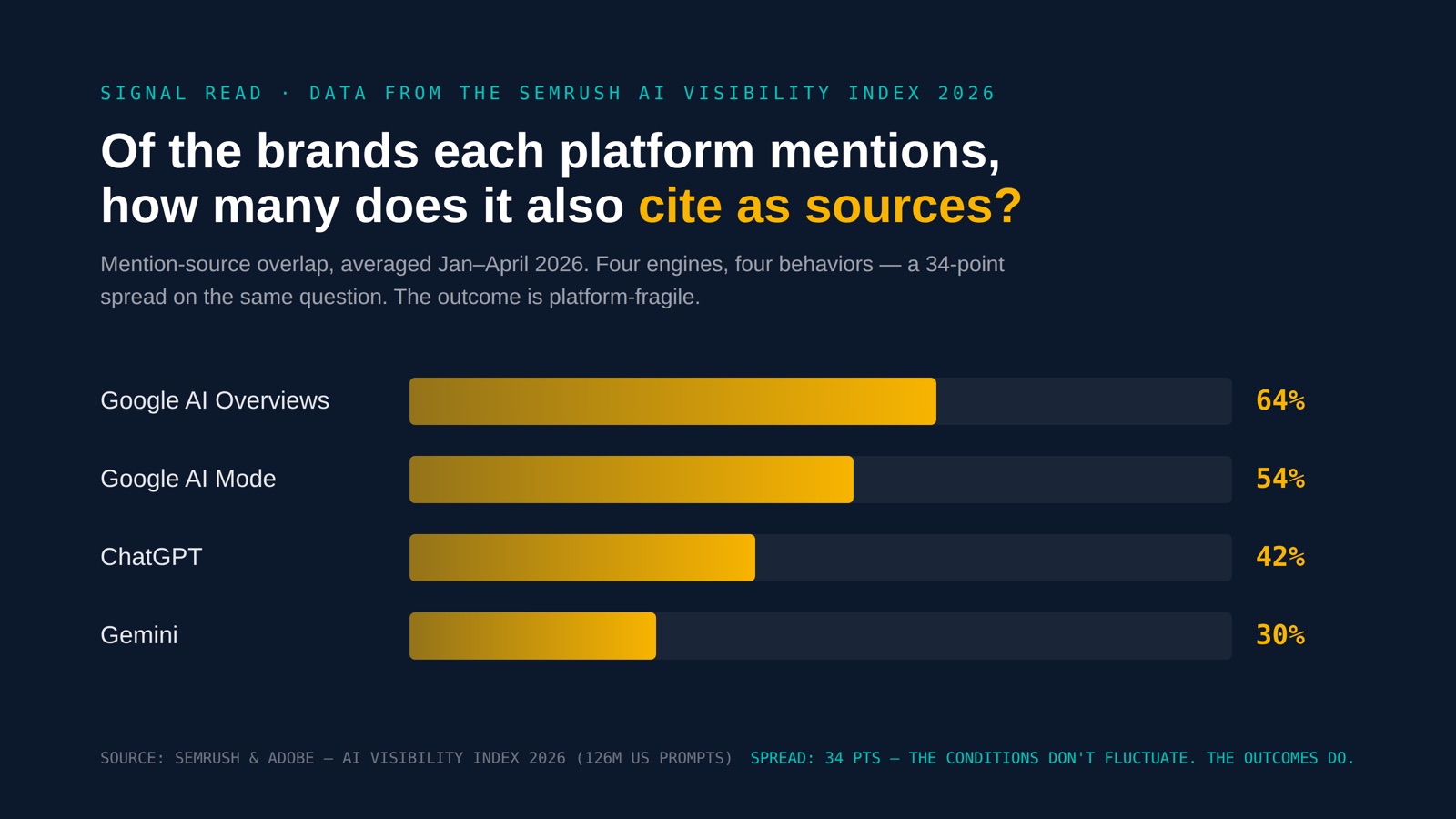
The four platforms Semrush tracked do not agree with each other. Of the brands each platform mentions, the share it also cites as a source runs from 64% on Google AI Overviews down to 30% on Gemini — a 34-point spread between highest and lowest.
| Platform | Mention-source overlap |
|---|---|
| Google AI Overviews | 64% |
| Google AI Mode | 54% |
| ChatGPT | 42% |
| Gemini | 30% |
Citation behaviour diverges just as sharply. ChatGPT pulls from an average of 15.4 sources per response, while Gemini pulls from 3.3 — more than a four-to-one difference for the same question. ChatGPT leans on Wikipedia and Reddit. Gemini leans on Google’s own surfaces. AI Overviews cites YouTube 83.2 million times across four months, more than double its next source.
And when a brand’s visibility lives at the end of that chain, it inherits the chain’s volatility. Cleveland Clinic — a genuinely authoritative institution — draws 86% of all its AI mentions from Google AI Overviews alone. Semrush states the risk themselves: if that one platform shifts how it weights health sources, the vast majority of Cleveland Clinic’s AI visibility could move with it. NerdWallet sits in the same position, with more than 85% of its brand mentions on a single platform.
Here is what I take from this, and it is the part the report gestures at but does not say outright. The outcome is platform-fragile. Four engines, four behaviours, four different answers about the same brand — and any of them can change next quarter. But the conditions — whether your site is readable, whether your content is extractable, whether the network of sources around you tells one consistent story — those are yours. They do not fluctuate with an algorithm update. They are the constant underneath four variables.
You cannot stabilise four outcomes you do not control. You can only stabilise the cause they all read from.
The four layers — and the order they run in
The most revealing page in the report is not a chart. It is a model.
Semrush propose that brand visibility in AI builds in four layers. First, AI has to find you — discoverability. Then it has to understand you correctly — clarity. Then it has to see you as qualified to include — authority. And only then does it trust you enough to recommend you.
Look at that sequence. Find. Understand. Qualify. Trust. And only at the end of it — recommendation, which is to say, visibility.
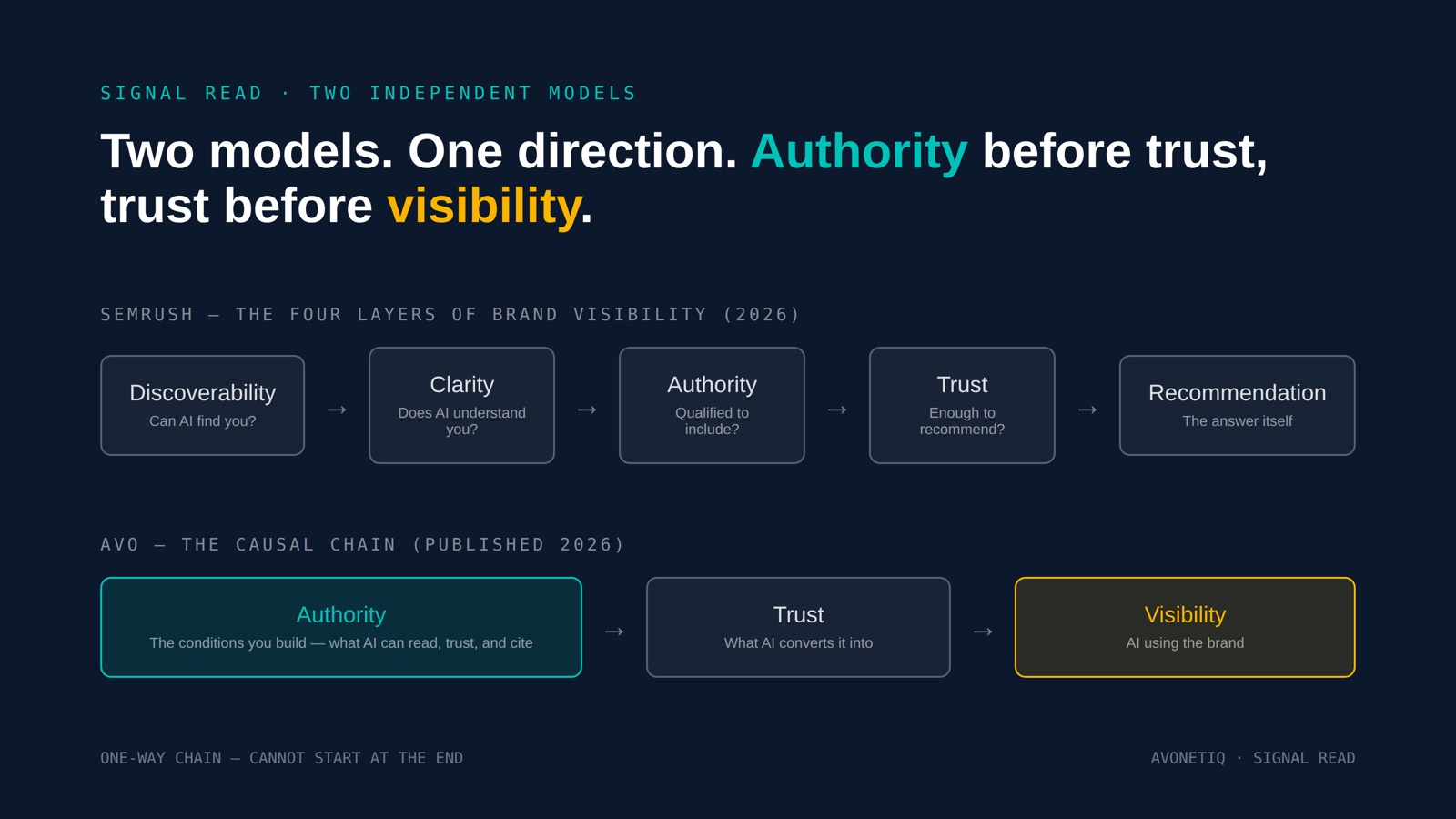
I recognise that sequence, because it is the one I have been teaching. In AVO — Authority & Visibility Optimization — the causal chain runs Authority → Trust → Visibility, and it runs in that order only. You build the conditions AI can read. AI converts those conditions into trust. Trust becomes the recommendation. When one of the industry’s largest research teams, working independently from a 126-million-prompt dataset, arrives at a four-layer model that ends in trust before it ends in recommendation — that is not a coincidence. That is convergence. The structure of the problem is asserting itself, no matter who measures it.
I take no issue with their model. I take confidence from it.
Where the report stops
And yet there is a boundary in this report worth naming honestly — not as criticism, but as observation.
Everything the Index measures sits at the end of the chain. Mentions. Citations. Visibility scores. The overlap between the brands AI names and the sources AI quotes. All of it is outcome — the result AI has already produced, observed after the fact.
- 45%
- Of 481 surveyed marketers cannot properly measure their visibility in AI answers.
- 9%
- Can measure all the metrics that matter — fewer than one in ten.
- 81% / 36%
- Teams with integrated SEO and AI search execution reporting more traffic or leads, versus siloed teams.
The report is candid about the consequence. Its prescribed self-audit for brand maturity is ten yes-or-no questions. Its strongest organisational finding is a finding about how teams are arranged, not about what any given brand should fix first.
So a brand finishing this report knows, with real precision, where it stands. What it still does not know is whether it is ready — whether the conditions that produce the outcome exist on its own domain and in its own signal network, and if not, which condition is missing.
That is the other half of the measurement problem. Outcome tells you what AI already decided. Readiness tells you what AI will decide next — and what you can do about it before the decision is made. A discipline needs both instruments, reading opposite ends of the same chain.
This is precisely where AVO stands. The Authority Score measures readiness — what AI can read, trust, and cite on your site — across the conditions that exist before any answer is generated. The Visibility Score measures the outcome — whether AI systems, in fact, use the brand. Prediction on one end. Verification on the other. Neither pretends to be the other, and neither is complete alone.
The seat is open
There is one more line in the report I want to leave you with, because Semrush wrote it better than I could have asked.
Discussing why citation strategy keeps failing inside organisations — split between content teams, PR teams, and brand teams that never coordinate — they conclude that this work needs connected effort, or “a new single discipline that owns it.”
I agree. That discipline exists. I named it AVO, published its methodology openly, and built the instruments that measure both ends of its chain.
The 2026 Index, read carefully, is its strongest independent evidence yet.
The report’s authors close by saying the 2027 Index will measure who acted on this one. I think that is exactly right. The measuring has been done. The acting is yours.
Sources & References
- Semrush & Adobe — AI Visibility Index 2026, January–April 2026 US dataset, 126 million prompts. All figures cited above are drawn directly from the published report.
- Wibowo, A. (2026). Authority & Visibility in the AI Search Era — the AVO methodology paper, defining the Authority → Trust → Visibility chain and the AS-VS measurement model.