Last week, Google published their official guide: “Optimizing Your Website for Generative AI Features on Google Search.”
Read it. Some of it is genuinely important.
Then notice the one thing it cannot say — because saying it would require Google to admit where their map ends.
The Number That Changes Everything
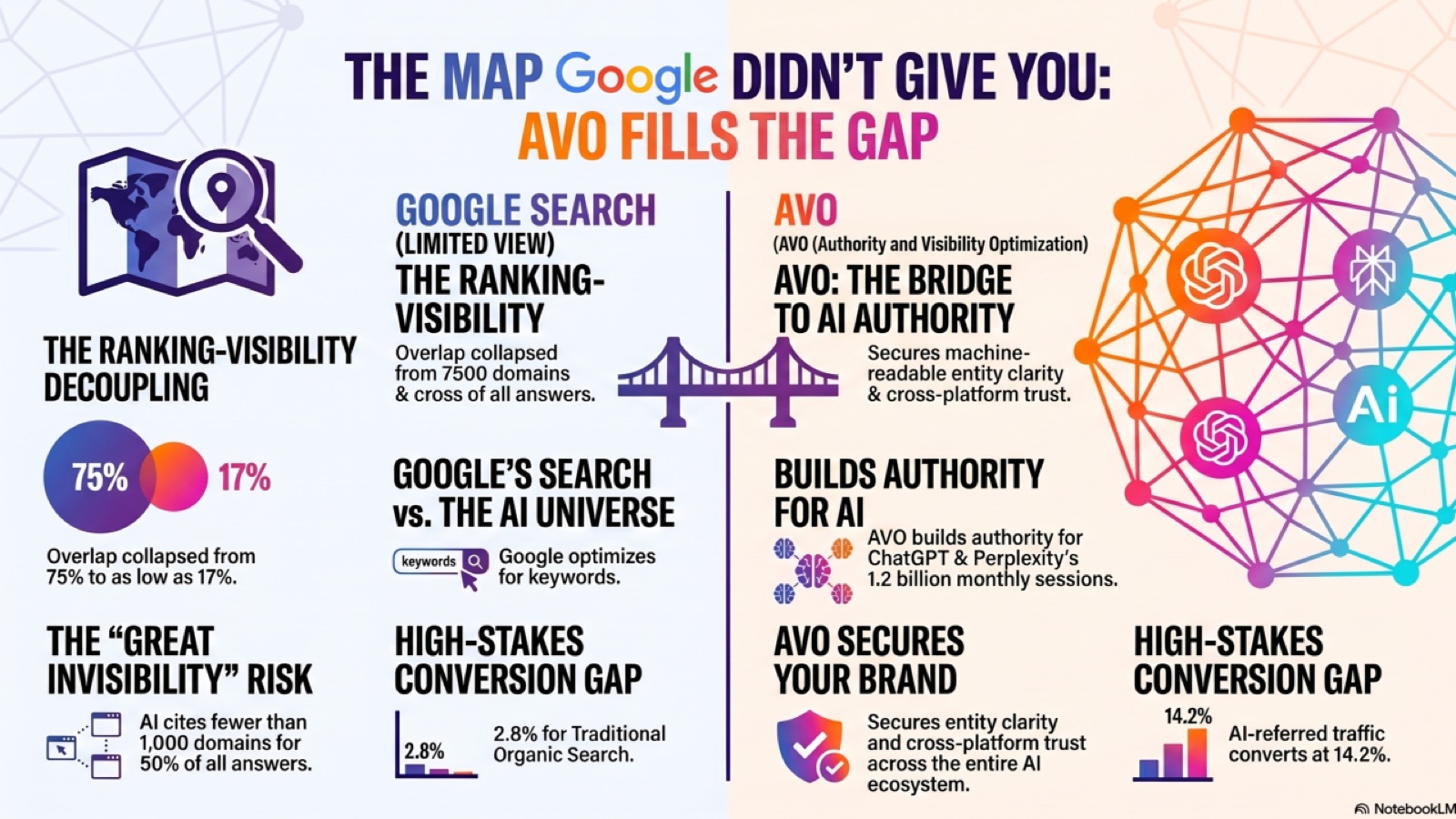
In late 2024, 75% of AI Overview citations came from pages ranking in Google’s top ten. By early 2026, that figure had collapsed to between 17% and 38%. (Ahrefs and BrightEdge, independently, February 2026.)
Sit with that for a moment.
A brand can hold a top-three position on Google and be completely invisible the moment a buyer asks ChatGPT, Perplexity, or Gemini for a recommendation. Ranking and visibility have been quietly decoupling for over a year. Most marketing teams are still measuring only one of them.
This is not a traffic fluctuation. This is a structural break.
What Google Got Right
To be fair: the guide describes something real.
Google’s AI systems use RAG — retrieval-augmented generation — where AI retrieves from authoritative sources and synthesizes an answer rather than matching keywords to pages. They correctly emphasize unique, expert, non-commodity content. They acknowledge that ranking signals alone are no longer sufficient.
The data backs the urgency. Organic click-through rates dropped 61% on queries where an AI Overview appears — confirmed by Seer Interactive’s study of 25.1 million impressions across 42 organizations (June 2024 to September 2025). Zero-click searches now account for 60% of all Google queries. In Google’s own AI Mode, that figure reaches 93%.
Semrush analyzed over 50,000 sites and found that while total web traffic was nearly flat in 2025, AI traffic grew 66% while organic search declined in 13 of 17 industries.
The traffic didn’t disappear. It moved. Google is right about that.
Where Their Guide Ends
Here is what Google’s guide cannot tell you.
It is scoped, explicitly, to “AI features on Google Search.” But the ecosystem where your buyers are making decisions is not only Google.
ChatGPT processes 250–500 million search queries every week. Perplexity handles 780 million monthly and grew 370% in the past year. AI chatbot sessions are doubling annually — reaching 1.2 billion monthly conversations in 2026. In Southeast Asia and India, AI referral traffic is growing at 200% year-over-year.
These platforms do not run on Google’s ranking systems. Performing well in traditional search does not make you visible in ChatGPT. Following Google’s guide does not get you cited by Perplexity. The mechanisms are different.
Google’s guide also tells practitioners that AEO and GEO — the disciplines focused on AI search visibility — are “just SEO.” I understand why they framed it that way. But it leaves practitioners working from an incomplete map.
SEO optimizes for keyword matching. AI systems synthesize answers. These are not variations of the same mechanism. They are structurally different processes.
When someone types a query into Google, the system returns a ranked list. The user clicks. When someone asks ChatGPT which brand to trust in your category, ChatGPT constructs a recommendation — evaluating which entities it recognizes, which sources it trusts, which brands carry the corroborating signals that allow it to cite them with confidence.
Your keyword ranking is not in that calculation.
The Problem Google Couldn’t Name
There is a condition I’ve been calling The Great Invisibility: the state where a brand ranks well in traditional search while being completely absent from AI-generated answers.
It is not a future risk. It is already the default state for most brands.
BrightEdge tracks thousands of prompts weekly across ChatGPT, Gemini, Perplexity, and Google AI Overviews. Their finding: 96.8% of cited domains saw zero change week-over-week — and when citations did shift, 87% of those movements were losses. AI citation is consolidating around a fixed set of recognized authorities. It is not redistributing. The door is not just narrow. It is closing.
This is not random selection. AI systems cite sources they can recognize as authoritative — sources with verified entity status, consistent cross-platform identity, structured credibility signals, and corroboration from other trusted sources. Brands without those signals are excluded systematically, regardless of their search rankings.
Understanding this requires a different mental model. Stop thinking about a keyword ranking table. Think instead about a Signal Funnel — the levels at which AI progressively recognizes a brand:
- Mentioned — the AI knows your brand exists
- Listed — your brand appears in an enumerated set
- Recommended — the AI explicitly endorses you
- Top Pick — the AI singles you out as the primary choice
- Cited — the AI links directly to your content as a source
Most brands are not even at Mentioned. That is The Great Invisibility. And no amount of keyword optimization closes that distance.
What Actually Moves the Signal Funnel
The brands appearing consistently in AI citations share characteristics that have nothing to do with search rankings.
Entity clarity. AI systems cite sources they can identify as a coherent, verified entity — consistent identity signals across website, social presence, third-party mentions, and structured data. Fragmented or ambiguous digital footprints default to uncertainty. Uncertain sources don’t get cited.
Earned external validation. Ahrefs found that brand web mentions correlate at 0.664 with AI citation rates — roughly three times stronger than backlinks at 0.218. Knowledge graph presence, third-party citations, industry corroboration: these are not vanity metrics in this model. They are the mechanism.
Non-commodity expertise. Google got this right. If your content says what every other source already says, it is redundant to AI’s synthesis process. Unique, structured expert perspective is what survives the filter.
Machine-readable authority. AI doesn’t interpret. It reads what is explicitly encoded. Expertise, credentials, authorship, and organizational identity need to be structured in a language machines can parse — or the system defaults to uncertainty.
The discipline that addresses all four of these systematically is what I’ve been building at Avonetiq — AVO: Authority and Visibility Optimization. It sits above GEO, AEO, and AIO as the strategic layer those tactics operate within. And its absence is why most brands are invisible to AI despite doing everything their SEO playbook tells them to do.
The Upside Nobody Is Talking About
Here is what gets buried under the traffic decline headlines.
For B2B and professional services, AI-referred traffic converts at 14.2% — versus 2.8% for traditional organic. A five-times gap. (Opollo, 312 IT and technology firms, Q3 2024–Q1 2025.) Visitors arrive pre-qualified because the AI has already done the comparison work. By the time they click, the consideration phase is largely complete.
And the window is genuinely early.
BrightEdge’s data makes this concrete: citation patterns are already consolidating. The brands earning recognized authority now are building a position that compounds — each citation strengthening recognition, each recognition making the next citation more likely. The brands building that flywheel today will be structurally difficult to displace in three years. Not because they’ll have more content. Because they’ll have more verified, machine-readable authority — and that compounds in ways paid spend cannot replicate.
What to Do With Google’s Guide
Read it. Apply it. The foundational advice is sound.
Then ask yourself the question it cannot answer:
What is your strategy for the platforms that don’t run on Google’s ranking systems?
Your buyers are already there. And right now, for most brands, the answer to that question is The Great Invisibility.
That is the map Google couldn’t give you.
Source. Originally published on LinkedIn, 22 May 2026: https://www.linkedin.com/pulse/google-finally-told-marketers-how-optimize-ai-search-heres-wibowo-qmjse/