
For six months, I’ve asked brand owners to open ChatGPT or Perplexity, enter a customer question, and read the AI’s answer aloud.
Silence always follows.
It’s not because the AI is wrong. It’s because it gets the answer right — without mentioning their brand. Sometimes it names a competitor, or worse, just describes the category as if no brand matters.
That silence is where this article begins. And it’s what led me to spend six months analyzing, testing, and reverse-engineering how AI systems actually decide which brands to recommend — research that ultimately became the foundation of AVO, the AI Visibility Optimization tool I built at Avonetiq.
“While keywords are definitive, AI is semantic. AI identifies the input and generates an answer using the available data. Our job is to make sure our brand is around AI all the time — and sexy enough to be cited.” — Alexandro Wibowo
The Core Problem: Two Systems, One Question, Completely Different Logic
Let’s ground this properly. When someone types “best CRM for small business” into Google, the search engine does something very specific. It crawls its index, evaluates roughly 200 ranking signals — such as backlink profiles, keyword density, domain authority, page speed, and mobile responsiveness — and returns an ordered list. Ten blue links. Sometimes ads above them. Sometimes, a featured snippet is pulled from the highest-ranking page.
The critical thing to understand is what Google is doing here: it’s sorting. It’s saying, “here are your options, ranked by my assessment of relevance and authority.” The user still makes the choice. Google is the librarian pointing you to the right shelf. You still pick the book.
Now type that same query into ChatGPT. Or Perplexity. Or Gemini with AI Mode active.
Something fundamentally different happens.
Instead of generating a list, the AI applies a reasoning process. It reviews its training data, structured sources, and the relationships between different entities. The AI evaluates topical authority signals and weighs how these factors fit together to answer the question. The response is not just reciting facts — it is the AI forming a judgment: “Based on what I understand about this category, here’s my recommendation and the reasons for it.”
That’s not ranking. That’s reasoning.
Recognizing this core difference between ranking and reasoning shapes every practical consideration for digital visibility strategies. To understand how to adapt, let’s now explore each system’s operation step by step.
How Ranking Works: The Logic of Lists
Traditional search works on what I’d call index logic. The search engine maintains a massive index of web pages. When a query comes in, it matches that query against its index using a combination of relevance signals. The page that best satisfies the algorithmic criteria gets position one. The next best gets position two. And so on.
The model is fundamentally competitive and positional. You win by being higher than someone else on a list. The optimization strategies that emerged from this model are well understood by now: build backlinks to increase domain authority, optimize title tags and meta descriptions for click-through rates, structure content around target keywords, and improve Core Web Vitals for a technical advantage. All of it is designed to push you higher on the list.
And for twenty years, it worked. It worked incredibly well. Entire industries were built on it. Careers were made.
But the model had a built-in assumption that nobody questioned: that the user would always be presented with a list and would always click on something.
That assumption is broken.
How AI Works: The Logic of Understanding
This is where my research got interesting. After hundreds of structured tests across ChatGPT, Perplexity, Gemini, and Copilot — asking the same questions in different ways, tracking which brands appeared and which didn’t, and mapping the patterns that led AI to choose one brand over another — a clear picture emerged.
Large language models don’t keep a list of pages or just match keywords to them. Instead, they understand the meaning, context, and intent behind your question.
When an AI responds, it uses what it knows about brands (does it recognize your brand?), your brand’s expertise in certain areas, where your brand is mentioned by trusted sources, and information it can read from your site.
The output isn’t a sorted list. It’s a synthesized narrative. The AI doesn’t say “here are ten options.” It says, “Here’s what I understand about this topic, and here’s who I’d point you to.”
This is closer to how a well-informed friend answers a question than how a search engine processes a query. If you ask a friend who’s deep in the fitness industry what protein powder to buy, they don’t hand you a ranked list of twenty options. They tell you two or three, explain why, and give you context. That’s what AI does.
The implications are enormous. In a list, there’s room for ten. In a recommendation, there’s room for one or two. The criteria for making that shortlist are completely different from those for ranking on a search results page.
Five Structural Differences Between Ranking and AI Recommendation
Through my testing and analysis, I identified five structural differences between how ranking and AI recommendations actually work. These aren’t theoretical — they’re derived from observing how AI systems behave across thousands of prompts.
-
Input: Keywords vs. Intent. Search engines process keywords. You type “best CRM small business,” and the engine matches those words against its index. AI processes natural language intent. You ask, “What CRM should I use if I’m a ten-person team that needs strong email integration?” The AI interprets the full context — team size, specific feature need, and implicit budget constraint. Keywords and intent are not the same thing.
-
Process: Matching vs. Synthesis. Search engines match and sort. AI synthesizes and reasons. A search engine finds the pages most relevant to your keywords and orders them. An AI reads across multiple sources of knowledge, evaluates which entities are most associated with expertise in the relevant domain, and constructs an original response. One is retrieval. The other is generation.
-
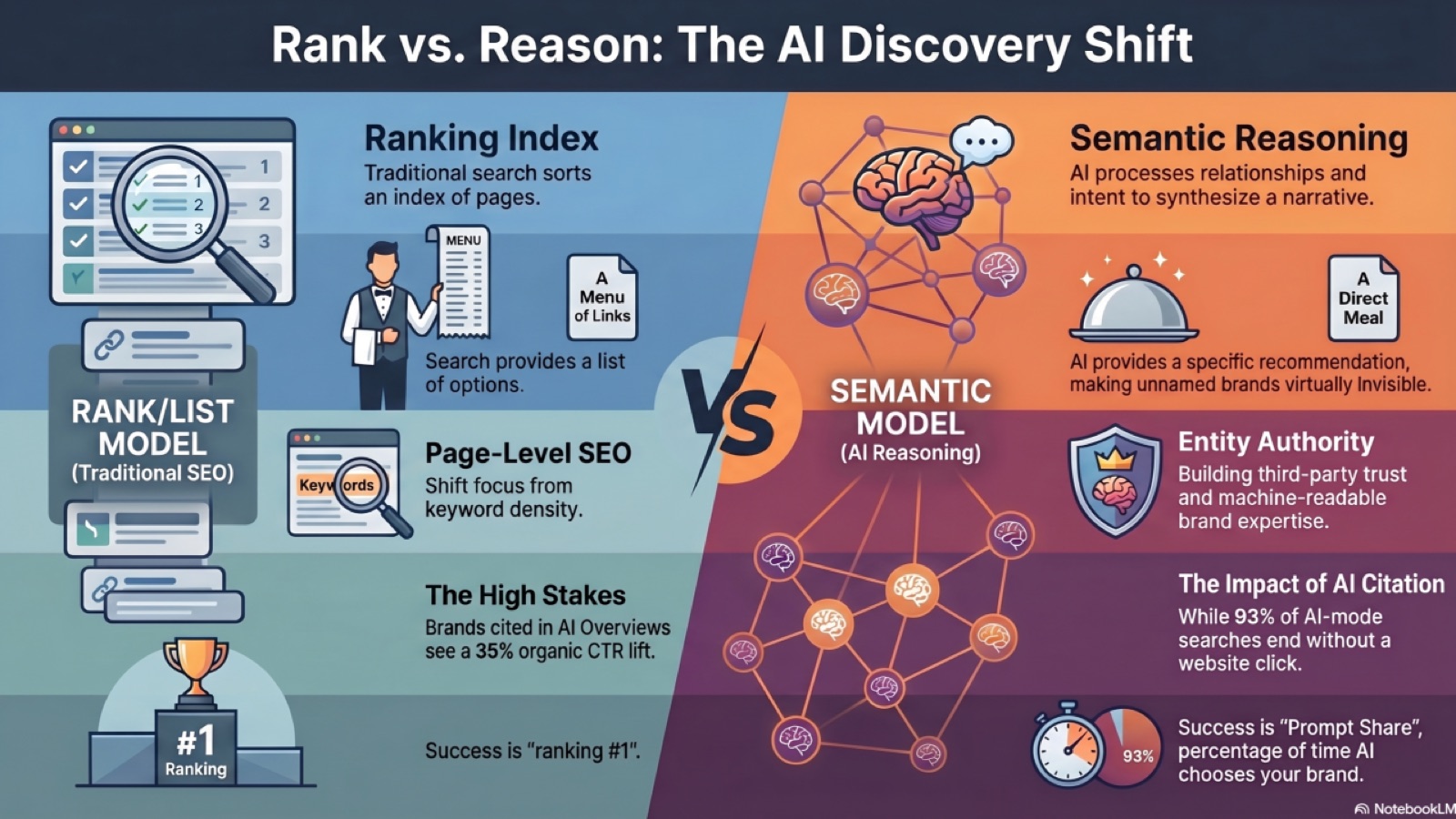
Output: A Menu vs. A Meal. Search gives you a menu. AI gives you a meal. The list format means every result has a chance to earn a click. The recommendation format means if you’re not named, you don’t exist in that interaction. There’s no “page two” of an AI response. There’s the answer, and there’s not being in it.
-
Visibility Signals: Page Optimization vs. Entity Authority. In traditional search, you earn visibility through page-level optimization — keywords, backlinks, technical SEO, content length, and internal linking. In AI, you earn visibility through entity-level authority — does the AI recognize your brand as a distinct entity? Does it associate you with specific expertise? Is your brand referenced in the kind of sources AI systems trust? Fundamentally different signals.
-
Measurement: Position vs. Prompt Share. In search, you measure position. Where do you rank for target keywords? In AI, you measure what I’ve come to call prompt share — when someone asks AI about your category, what percentage of the time does your brand appear in the answer? Position is a number on a list. Prompt share is a presence-or-absence question. This concept became one of the core metrics inside AVO.
The Data: Why This Matters Right Now
I could make a theoretical argument here, but the data is more convincing.
Google AI Overviews appeared in about 13% of searches a year ago. That number is now closer to 25%, with over 2 billion monthly users interacting with AI-generated summaries in search results (TechCrunch, July 2025). When Google’s AI Mode is active, 93% of searches resolve without the user clicking on any website.
Google is systematically training its users to stop clicking. A Pew Research Center study from July 2025 confirmed that users click traditional links only 8% of the time when an AI summary is present, compared to 15% without one. ChatGPT, with its hundreds of millions of daily users, has trained people to never start clicking in the first place.
But here’s what makes this not just a traffic story. Research from Seer Interactive (September 2025) found that brands cited in AI Overviews see a 35% lift in organic click-through rate compared to those that aren’t cited. In paid search, the lift is even more dramatic — 91% higher CTR for cited brands.
So it’s not that traffic is disappearing uniformly. It’s concentrating. The brands that AI recognizes and recommends are gaining disproportionate visibility. Everyone else is fighting for scraps of a shrinking pie.
BrightEdge tracked this over sixteen months (May 2024 to December 2025) and found something critical: the correlation between traditional organic ranking and AI citation is strengthening. Pages from the top 10 organic results being cited in AI responses grew from about 32% to over 54%. Traditional SEO still matters — but as a foundation, not a ceiling. Good rankings increase your odds of being cited by AI. Rankings alone don’t guarantee it.
This is precisely what I found in my own testing. Brands with strong SEO were more likely to be mentioned by AI. But the ones that actually got recommended — the ones AI named with confidence — had something more. They had entity clarity. Structured knowledge. Third-party validation that AI systems could verify. They didn’t just rank well. They were understood.
The Real Shift: From Optimization to Authority
Here’s what I think most people in this industry are missing. This isn’t an incremental change to SEO. It’s not “SEO plus AI” or “SEO 2.0.” It’s a different discipline.
In the ranking era, you optimized pages. In the AI era, you build entity authority. In the ranking era, you measured position. In the AI era, you measure whether you exist by the answer itself. In the ranking era, you competed for a spot on a list. In the AI era, you compete for a place in the machine’s understanding of your category.
This is what drove me to build AVO. Not as a replacement for SEO tools — there are plenty of those — but as the first tool developed specifically to measure and optimize how AI systems see your brand. Because you can’t improve what you can’t measure. And until now, nobody was measuring this.
The brands that get this right won’t just survive the shift. They’ll own it. Because there’s something interesting about AI recommendation dynamics that I’ve observed consistently across my research: once an AI system associates your brand with authority in a domain, that association compounds. It shows up across platforms, across queries, across contexts. Unlike a search ranking — which you can lose overnight to an algorithm update — entity authority in AI builds on itself.
That’s the prize. Not position one on a results page that fewer people look at every quarter. But the presence in the answer is what more people trust every day.
What To Do Next: The 30-Second Test
Before you rethink your entire strategy, start with the test I mentioned at the top.
Open ChatGPT. Open Perplexity. Open Gemini. Ask every single question that a real potential customer would ask about your category. Not your brand name — your category.
- “What’s the best accounting software for Indonesian SMEs?”
- “Which digital agency in Jakarta specializes in e-commerce?”
- “What meal delivery service is best for someone trying to lose weight?”
Whatever your version of that question is. Ask it. Read the response.
If your brand appears, pay attention to how you’re described and whether you’re recommended or merely mentioned. There’s a difference.
If your brand doesn’t appear, you now know something that no keyword ranking report would have told you: in the fastest-growing discovery channel on the internet, you’re invisible.
That’s not a problem you can solve with better meta descriptions.
It’s a problem that requires a fundamentally different approach to how you build, structure, and project your brand’s authority. And the sooner you start, the wider the gap between you and every competitor who’s still staring at page one.
Sources & References
- Pew Research Center (July 2025) — AI summary impact on click-through behavior
- Seer Interactive (September 2025) — AI Overview citation impact on organic and paid CTR
- BrightEdge (May 2024–December 2025) — 16-month correlation study on organic ranking and AI citation
- TechCrunch (July 2025) — Google AI Overviews reach 2B monthly users
- Semrush AI Overviews Study (July 2025) — Organic CTR decline with AI Overviews present
Source. Originally published on LinkedIn, 14 April 2026: https://www.linkedin.com/pulse/rankings-vs-recommendations-why-ai-doesnt-care-your-position-wibowo-8fcgc/