
Start with the number that matters most, because it reframes everything you think you know about a “finished” page.
When an AI engine cites your page, it does not keep citing it. It holds the position for a while, then swaps you out for something it judges more current. Researchers have started measuring how long that “while” actually is, and the answer is shorter than almost any content schedule assumes. It is measured in weeks.
This is not an argument or a prediction. It is what the citation data now shows. The rest of this piece is the data, what it means engine by engine, and the one rule it points to.
What “shelf life” means here
The cleanest way to think about it is a citation half-life: the time it takes for half of an engine’s cited sources to be replaced by fresher ones. If an engine’s half-life is four weeks, then roughly half the pages it cites today will be gone from its answers in a month — not because they got worse, but because the engine kept moving.
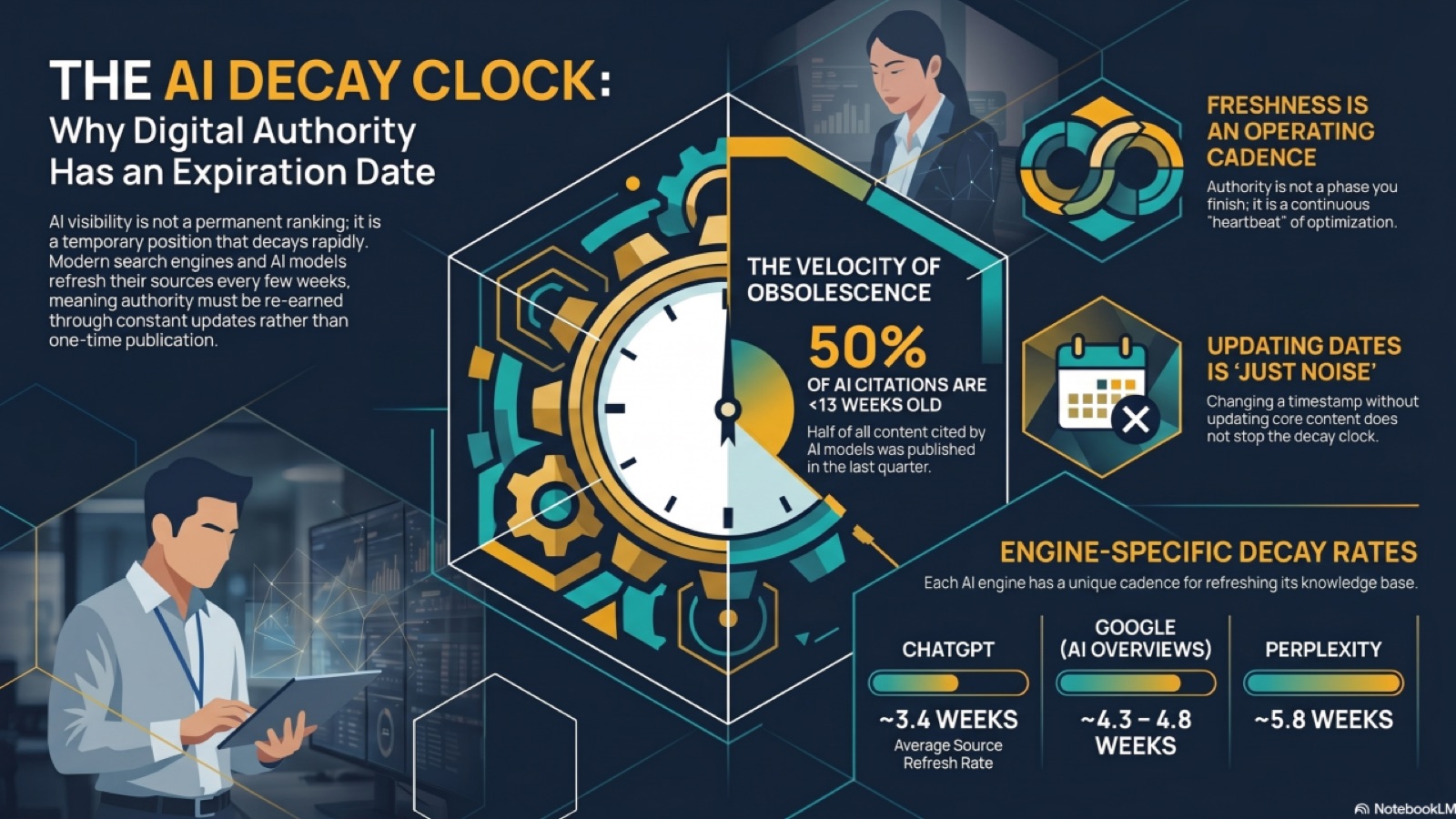
Scrunch measured this across 3.5 million citation events. The numbers are specific, and they differ sharply by engine.
| Engine | Citation half-life (approx.) |
|---|---|
| ChatGPT | 3.4 weeks |
| Google AI surfaces (AI Mode, Gemini, AI Overviews) | 4.3 – 4.8 weeks |
| Perplexity | 5.8 weeks |
Read ChatGPT’s row again. Half the sources it cites are replaced inside a month. A page you earned a citation for in early January is, on average odds, no longer the source it uses by early February — unless something kept it current.
Two other studies frame the same picture at the population level. Amsive’s 2026 analysis found that about half of all content AI engines cite is less than thirteen weeks old. Ahrefs, analysing roughly seventeen million citations, found AI-cited pages running about a quarter fresher than the pages that rank in classic Google results — a pattern, they note, rather than a guaranteed cause. Different methods, same direction: AI search runs on a short clock.
These studies come from companies that sell visibility tooling, and I read them with that in mind. I trust the direction because it matches what I see in assessment after assessment — not because a vendor published it.
Why a short clock is a trust problem, not a ranking one
It is worth being clear about why age costs you a citation, because it changes what you do about it. In traditional search, decay was a gradual ranking slip — easy to ignore. In AI search it is something else. An engine constructing an answer evaluates freshness as a signal of whether a source still maintains its knowledge. Content that cites 2022 figures in 2026, or describes tools and rules that have since changed, does not merely underperform — it signals that the source is no longer being kept current, and a source that does not maintain its knowledge is one the engine stops trusting. I argue this at length in OMG! How to Make AI Choose Your Brand: in the AI era, decay is not a ranking problem, it is a trust problem.
This is why the AVO framework I set out in Authority and Visibility in the AI Search Era does not treat freshness as a single signal. It measures it in two places at once — as content-update-signals under Manifest (visible evidence of maintenance: last-updated dates, changelogs, version numbers) and as content-freshness under the Generative pillar’s Trust Alignment vector (AVO white paper, §5.4). One asks whether the page shows it is maintained. The other asks whether the engine treats that maintenance as a reason to keep trusting you.
Your shelf life also depends on your industry
The engine sets most of the clock, but not all of it. The same Scrunch data found citation durability varies by sector. Sources in insurance (about 5 weeks) and financial services (about 4.8) held longest — categories where authoritative, slow-moving reference content dominates. Healthcare (about 4.1) and retail and e-commerce (about 4.3) turned over fastest, where timeliness drives more frequent rotation.
The useful conclusion from their data is the order of leverage: the platform you are cited on affects durability more than the industry you are in. A healthcare brand cited on Perplexity still tends to outlast an insurance brand cited on ChatGPT. Which means the engine your buyers actually use is the single biggest factor in how often you have to re-earn your place — and most brands have never decided which engine that is on purpose.
Why the weeks differ
The engines do not share a retrieval system, which is the likeliest reason their shelf lives diverge.
All of them work the same way at the top: every model has a knowledge cutoff, so to answer about the present it retrieves live pages from an index and builds the answer from those. That is why recency is structural, not a setting that can be switched off. But the indexes underneath differ. ChatGPT has drawn heavily on Bing’s index; Perplexity runs its own crawler and a real-time index; Google’s AI surfaces inherit the cadence of Google Search. Different plumbing, different appetite for fresh sources — which lines up with the different half-lives, even if no study has proven the causal link outright.
There is also a reason some of your pages will sit well above these averages and some well below: recency expectations are not uniform. AVO’s content-freshness datapoint is defined with category-aware recency thresholds (AVO white paper, §5.4) — the same idea search engineers have long called query-deserves-freshness. A query about this quarter’s pricing demands a current source; a query about a settled definition does not. It is why a genuinely evergreen page can hold a citation for a year while a “best X for 2026” page expires in weeks. Know which kind of page you are looking at before you assume it is decaying.
The rule the data points to
Convert the weeks into one operating rule and the whole thing becomes manageable:
Your refresh interval has to be shorter than the citation half-life of the engine your buyers use.
This is the logic behind running content maintenance on a fixed rhythm rather than on inspiration. In AVO terms it is the Manifest cycle, which the methodology sets at roughly four to six weeks (AVO white paper, §4.6) — close to the window in which a citation turns over on most engines. The one place that rhythm is already too slow is ChatGPT: a 3.4-week half-life means a monthly cycle is racing to keep up. If your audience lives there, you tighten the loop or you accept you will surface less often. The half-life is the deadline. Treat it like one.
That does not mean refresh everything. It means triage, in this order:
- Does the page feed the business? If it is not on a path to pipeline, let it age. Refresh effort is a budget; spend it where citations convert.
- Is the query volatile or settled? Volatile, commercial, fast-moving questions are racing the clock and need a live cadence. Settled questions are not — defend those differently.
- Which engine carries the audience? That answer sets the deadline, using the table above.
The handful of pages that feed the business, answer a volatile query, and live on a fast engine are the ones racing a three-to-five-week clock. That is where your attention goes.
What does — and does not — extend the shelf life
Two things are worth knowing about lengthening the clock.
What does not work is changing the date. If recency wins, the tempting shortcut is to swap a 2025 for a 2026 and call the page refreshed. Google’s John Mueller said it plainly, years before AI search existed: changing the date with no real change behind it is “just noise & useless.” The engines are not reading your timestamp; they are detecting whether the content actually moved. A real refresh means replacing stale numbers, adding what was not there, and cutting what is now wrong — then letting the date reflect a change that genuinely happened.
What does appear to extend it is authority. The same Scrunch study found citations from established, trusted sources lasting roughly twice as long as the average. That finding is suggestive rather than settled — it was measured on news-publisher domains, not on brands generally — but the direction is intuitive, and it is exactly what AVO’s Generative pillar is built to engineer: external validation, entity recognition, and trust signals the engine cannot read off your timestamp and that do not reset every cycle (AVO white paper, §4.2, §5.4). Even at its best, though, authority lengthens the shelf life; it does not remove it. Twice 3.4 weeks is still under two months. There is no page that does not eventually need re-earning.
You cannot manage a shelf life you cannot see
A clock you are not watching is not a deadline — it is a surprise. AVO pairs two instruments to turn the weeks into something you can run a cadence against, and they do different jobs on purpose (AVO white paper, §5–§6).
The Visibility Score is empirical. It measures whether you are actually being cited right now — presence, endorsement, and prominence in answers across platforms, with confidence intervals on the numbers. It is how you know a citation has expired rather than guessing. It is the proof.
The Authority Score is predictive. It measures engineered readiness for citation across thirty-six datapoints — content freshness among them, in the two places noted above. It is where you check whether a page is structurally still a candidate before you spend a cycle refreshing it: a prediction of the conditions for citation, not proof of the outcome.
One tells you the shelf life expired. The other tells you whether the page is even still in the running. You need both to refresh the right pages at the right time instead of refreshing on a hunch.
What to do this week
Take the handful of pages that actually feed your pipeline. For each, find the citation half-life of the engine your buyers use, and check when the page last changed in substance — not in date. Then ask ChatGPT, Perplexity, and Google’s AI the questions those pages were built to answer, and see whether you still appear.
Where the last real update is older than your engine’s half-life and you have dropped out of the answers, that page is past its shelf life. Refresh the substance, let the signals follow, and re-check in three weeks.
The full pillar logic, the thirty-six datapoints, and the Authority and Visibility Scores that measure them are set out in the AVO white paper and in OMG! How to Make AI Choose Your Brand. The map is in the book. The clock is the work.
One last thing, because the subject demands it. This article carries a review date. Writing about shelf life and then letting the piece pass its own would prove the point the wrong way.
References
- Wibowo, A. Authority and Visibility in the AI Search Era (AVO white paper, v1.0). The foundational AVO framework — the OMG Protocol (Optimize, Manifest, Generative), the six measurement vectors and thirty-six datapoints, and the paired Authority Score and Visibility Score. Cited above: §4.2, §4.6, §5–§6, §5.4.
- Wibowo, A. OMG! How to Make AI Choose Your Brand (v7.3). On content decay as a trust problem and the refresh discipline.
- Scrunch — Citation half-life by engine and by industry, plus the trusted-source durability finding, from 3.5M citation events: https://scrunch.com/blog/half-life-of-ai-citations
- Amsive (2026) — ~50% of AI citations come from content less than 13 weeks old: https://rank-and-convert.ghost.io/the-13-week-rule-how-content-freshness-drives-ai-search-citations/
- Ahrefs — ~17M AI citations analysed; AI-cited content ~25.7% fresher than top-10 organic (a pattern, not a causal multiplier): https://foglift.io/blog/content-freshness-ai-search
- John Mueller / Google — “Changing the date without doing anything else is just noise & useless” (2022), consistent with 2019 and 2021 guidance: https://www.seroundtable.com/google-update-content-date-32878.html
Third-party figures are from independent studies published in 2025–2026; methodologies and exact numbers vary, so treat them as directional. Last reviewed: June 2026.
Source. Originally published on LinkedIn, 10 June 2026: https://www.linkedin.com/pulse/shelf-life-ai-citation-alexandro-wibowo-mpolf