
Late 2022. ChatGPT was four days old and I was using it like everyone else — to win arguments and write emails I didn’t want to write. Then I asked it something I actually cared about: the best design freelance platforms in Indonesia. It named my own company. Unprompted. I’d told it nothing about me.
I didn’t feel proud. I felt unsettled. Not because it was wrong — because it was right, and I had no idea how it knew.
I’ve spent a lot of the three years since watching this thing turn from a party trick into the place people quietly make real decisions. And on May 5th, that place opened a cash register.
This isn’t a think-piece about whether AI ads are good or evil. You’re an operator. You have a budget and a finite number of bets. So let’s do the unglamorous thing and actually work out whether this one is yours to make.
What actually changed
On May 5, 2026, OpenAI opened ChatGPT’s Ads Manager to every US business. No agency. No minimum spend. Self-serve at ads.openai.com. The $50,000 floor that gated the pilot — itself down from a $200,000 commitment a few months earlier — is gone. You can now fund a test campaign with lunch money.
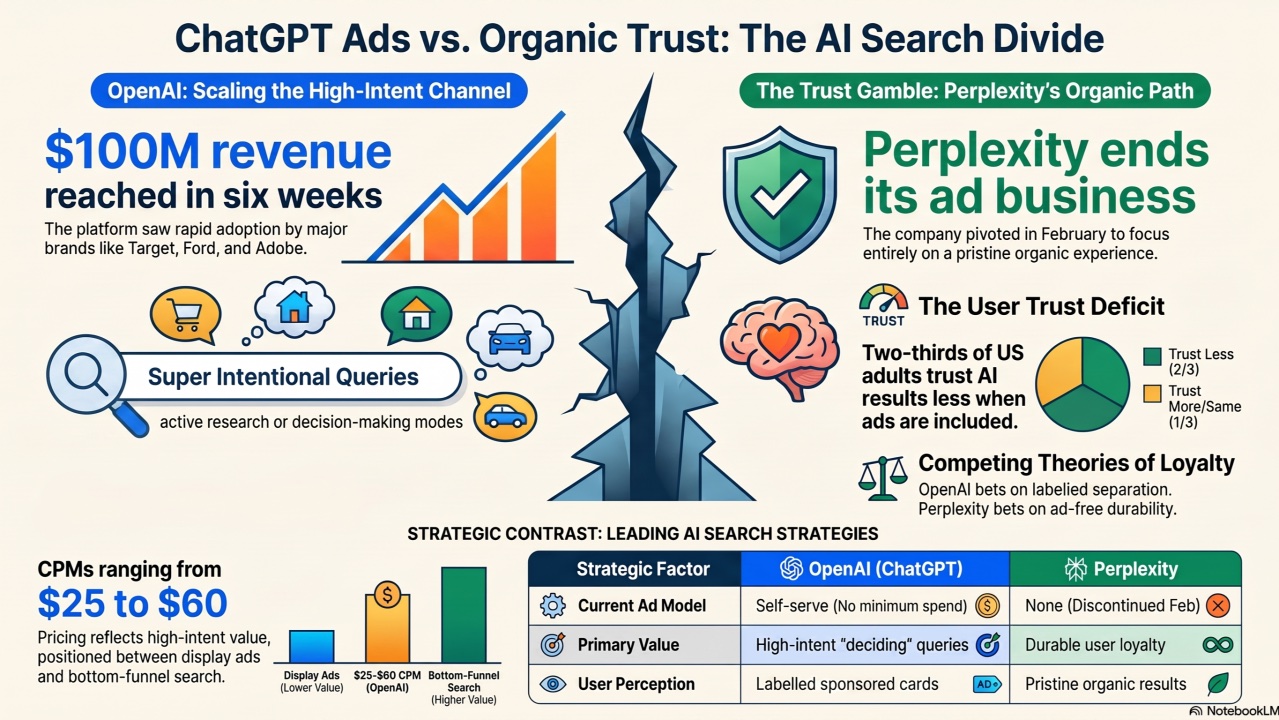
The pilot that preceded it wasn’t a toy. Reuters reported it crossed $100 million in annualized revenue in roughly six weeks. OpenAI says it’s aiming for $2.5 billion in ad revenue this year and $100 billion by 2030. (Analysts at Truist think the near-term figure is smaller — under a billion this year — but nobody’s arguing about the direction.)
Translation: a new paid channel just appeared, it’s growing fast, and most of you haven’t put a single dollar against it. That alone earns ten minutes of your attention.
The case for jumping in (which the skeptics undersell)
Let me make the bull argument properly, because the trust-panic crowd keeps skipping it.
First, the window. Every dominant ad channel was cheapest the year nobody believed in it. The earliest Google Ads buyers paid pennies for clicks that now cost a fortune. Early-mover pricing on a brand-new surface is a real, compounding edge — and it evaporates the moment your competitors wake up.
Second, the traffic behaves. Criteo’s data shows visitors arriving from LLM platforms convert at roughly 1.5x the rate of other referral sources. McKinsey found 55% of US adults say AI search already played a part in a consumer-electronics purchase. These aren’t tire-kickers. People act on what the machine tells them — I’m proof, and if you’re honest, so are you.
Third, OpenAI’s own early read was calmer than the headlines. In its March update it reported no measurable hit to consumer-trust metrics and low ad-dismissal rates. The sky, so far, has not fallen.
If you sell something a consumer researches before buying, and you’re in the US, the honest answer is: test it. Small. Now. Waiting out of squeamishness is its own expensive decision.
The case for sitting still (which the hype skips entirely)
Now the part the breathless posts leave out — the facts that actually decide this for most businesses.
Who can even see your ad? This is the big one. ChatGPT ads only show to users on the free tier and the $8 Go plan. Plus, Pro, Business, Enterprise — all ad-free. Read that again. If you sell to professionals, teams, or enterprises, the people with budget authority are paying $20 to $200 a month precisely so they never see an ad. You’d be buying reach among the platform’s least committed users. For a lot of B2B, that’s close to a dealbreaker, and no headline about $100 million in revenue changes it.
Can you even measure it? During the pilot, a reporting glitch left advertisers unable to see their own campaign data — and there’s still no independent, third-party measurement. You’re trusting OpenAI’s first-party numbers. Early click-through landed around 0.91%, well below Google Search. In fairness, click-through is a weak yardstick for an awareness unit sitting below a finished answer. But “trust us, it’s working, and no, you can’t fully verify it” is a hard sell to anyone spending real money.
Are you even eligible? Categories are still narrow — retail, travel, local services, entertainment, digital products — with health, mental health, and politics fenced off. And CPMs running roughly $25–$60 are about three times what Meta charges.
And where do you operate? Right now this is a US-and-a-handful-of-English-markets story. If you’re in Southeast Asia — a lot of you reading this from my side of the world — you can’t buy in yet, and new ad platforms typically take a year or two to arrive. That’s not a reason to look away. It’s a reason to be ready before the auction opens in your market.
You’re not just buying ads. You’re betting on a channel.
Here’s the strategic wrinkle most spend decisions ignore: the platforms themselves can’t agree on whether this channel should exist.
OpenAI is building it. Google runs ads in its AI Overviews but keeps Gemini itself clean. Perplexity killed its entire ad business in February, telling the Financial Times that once ads appear, “a user would just start doubting everything.” Anthropic bought a Super Bowl slot to say, “Ads are coming to AI. But not to Claude.” And the users are wary — an Ipsos survey of 1,085 US adults found 63% say ads make them trust AI results less.
So when you pour budget and creative into this, you’re betting on a surface that two of the four major players think is a mistake, and that a clear majority of users say they distrust. It might mature into a pillar of digital advertising alongside Search and Social. It might also get walled back if the trust math turns ugly. Both are live. Price that risk in before you scale, not after.
So — to ad, or not to ad?
Strip away the philosophy and it comes down to four questions:
- Does your buyer live on a free tier — or behind a paywall where your ad will never reach them?
- Is your market even live yet?
- Can you stomach spend you can’t fully measure, for the learning value of going early?
- Is your category eligible — and is the premium price worth the intent?
If you’re a US consumer brand, in an eligible category, selling things people research before buying — yes. Test it, keep it small, and move before the cheap window closes. The early-mover discount is the whole prize here, and it has a clock on it.
If you’re B2B, enterprise, or operating outside the US, the smarter money right now probably isn’t the ad buy at all. The channel will still be here — likely cheaper to learn and easier to measure — when it actually fits you.
And one last thing worth keeping on the same spreadsheet. Every constraint above — the tier limits, the geography, the on-off switch a platform can flip on a Tuesday — applies to the ad. None of it applies to being the brand the model already names when someone asks. That reaches every tier, in every market, and nobody can pull it.
Ads rent you a moment next to the answer. Being the answer is a different line item entirely — harder to buy, slower to build, and the only one that doesn’t vanish when OpenAI changes its mind.
Test the ads if they’re yours to test. Just don’t let a shiny new unit pull your eye off the bigger question underneath it: when AI is the one doing the recommending, is your brand something it already knows to name — or something you’ll always have to pay to stand beside?
Sources & References
- Reuters — ChatGPT ads pilot crossed $100M annualized revenue in roughly six weeks
- Truist — near-term ChatGPT ad-revenue estimate (under $1B this year)
- Criteo — visitors arriving from LLM platforms convert at ~1.5× other referral sources
- McKinsey — 55% of US adults say AI search played a part in a consumer-electronics purchase
- Financial Times — Perplexity on exiting its advertising business
- Ipsos — survey of 1,085 US adults; 63% say ads make them trust AI results less