
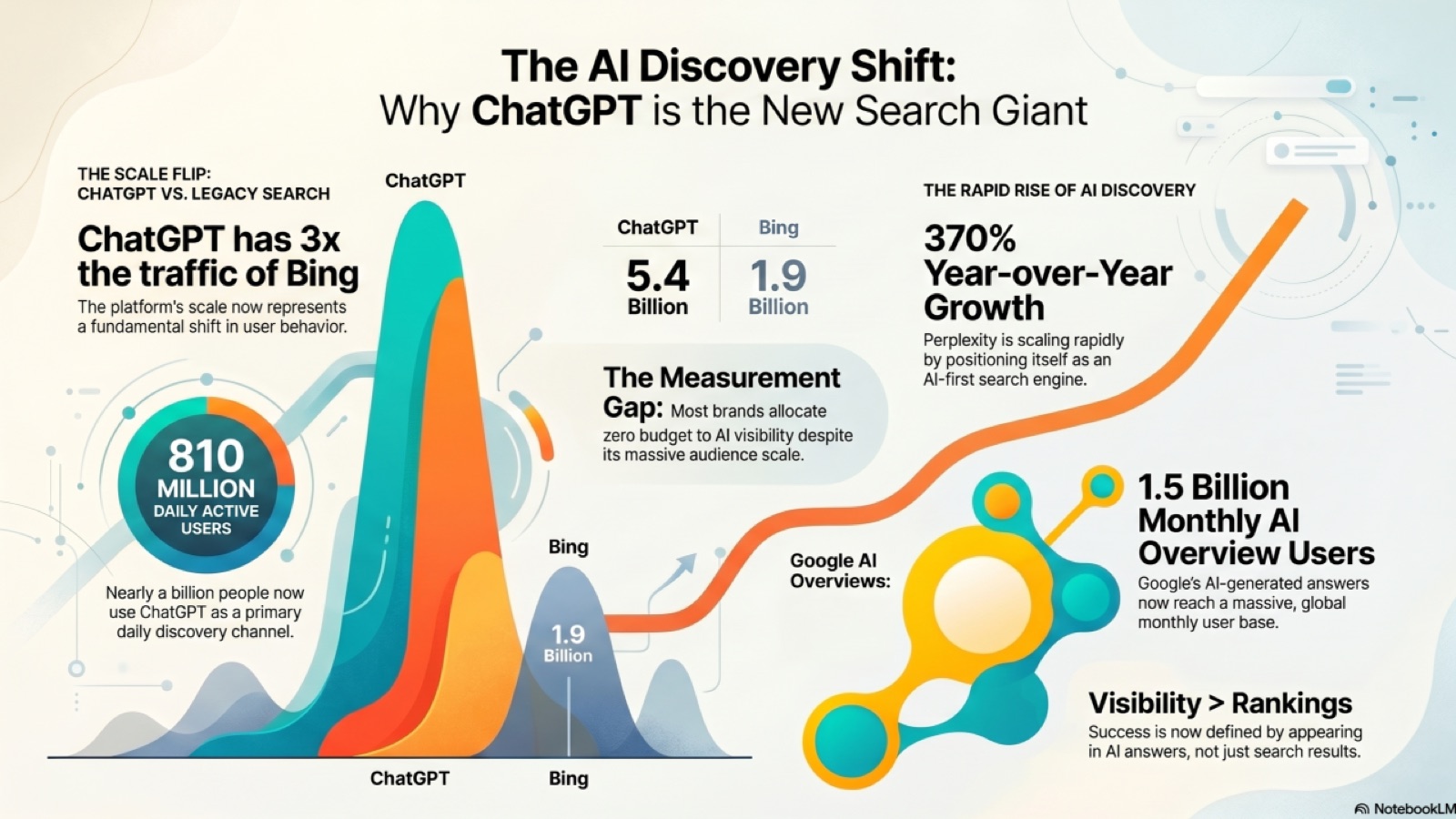
The audience moved. The measurement didn’t. And most brands are quietly invisible to a discovery channel three times the size of Microsoft’s entire search engine.
Walk into any marketing meeting this quarter and ask a simple question: “What’s our ChatGPT strategy?”
You’ll get one of three answers. A long pause. A confident pivot to “our SEO is strong.” Or — most often — a version of “we should probably look into that.”
Now ask the same room about Bing. Suddenly there’s a slide. There’s a budget line. There’s someone who owns it.
This is the gap I want to talk about. Because the numbers no longer leave room for debate.
The Numbers Aren’t Arguable Anymore
ChatGPT pulls roughly 5.4 billion monthly visits. Bing gets 1.9 billion. Around 810 million people open ChatGPT every single day.
Let that settle for a second. ChatGPT is not a niche tool for early adopters. It is not a productivity app sitting alongside your inbox. It is a primary discovery channel — one that is now substantially larger than Microsoft’s entire search engine.
And ChatGPT isn’t alone:
- Perplexity grew roughly 370% year-over-year, positioning itself as an AI-first search engine.
- Google AI Overviews now reach approximately 1.5 billion monthly users — meaning a huge share of Google searches are already being answered for the user, not by a list of blue links.
This is not a forecast. This is the present tense.
The Audience Moved. The Measurement Didn’t.
Here’s what I keep seeing in the field: most brands still allocate zero budget to understanding whether AI platforms recommend them, mention them, or even know they exist.
This isn’t a failure of intelligence. The marketing leaders I talk to are sharp. They sense the ground shifting. The problem is that there’s no inherited playbook for measuring AI presence the way we learned to measure search rankings, ad spend, or social engagement. So the work doesn’t get done — not because it’s unimportant, but because it doesn’t fit the existing dashboard.
Meanwhile, the audience is already there. Asking AI for product recommendations. Asking AI which firm to hire. Asking AI which platform to trust.
When AI answers those questions, your brand is either in the answer or it isn’t. There is no “page two.”
What I See From Where I Sit
I run an AI visibility platform from Indonesia. Every week, my team measures how 6 AI platforms respond to brand-related queries across 9 languages.
The gap between what brands think their AI presence is and what it actually is — it is consistently shocking. Companies with strong SEO. Companies with award-winning content. Companies with household-name recognition in their category. Many of them are simply not in the answer when AI gets asked.
This is what I call The Great Invisibility: ranking well in traditional search while being completely invisible to the systems people are now using to make decisions.
It’s not a future problem. It’s a now problem. And it’s measurable.
The Budget Will Follow the Audience
It always does. It did when search moved from directories to Google. It did when attention moved from television to mobile. It did when commerce moved from offline to marketplaces.
The brands that led each of those shifts didn’t wait for the budget allocation framework to catch up. They built the measurement, proved the channel, and the budget followed.
The brands that waited spent the next decade trying to recover ground they had given away for free.
The same shift is happening right now, in real time, with AI as the new primary interface between people and decisions.
The only question is whether you’ll be in the answer — or whether your competitor will.
Source. Originally published on LinkedIn, 27 April 2026: https://www.linkedin.com/pulse/your-brand-has-bing-strategy-wheres-chatgpt-alexandro-wibowo-zca3c/